Renesas RZ/V2H
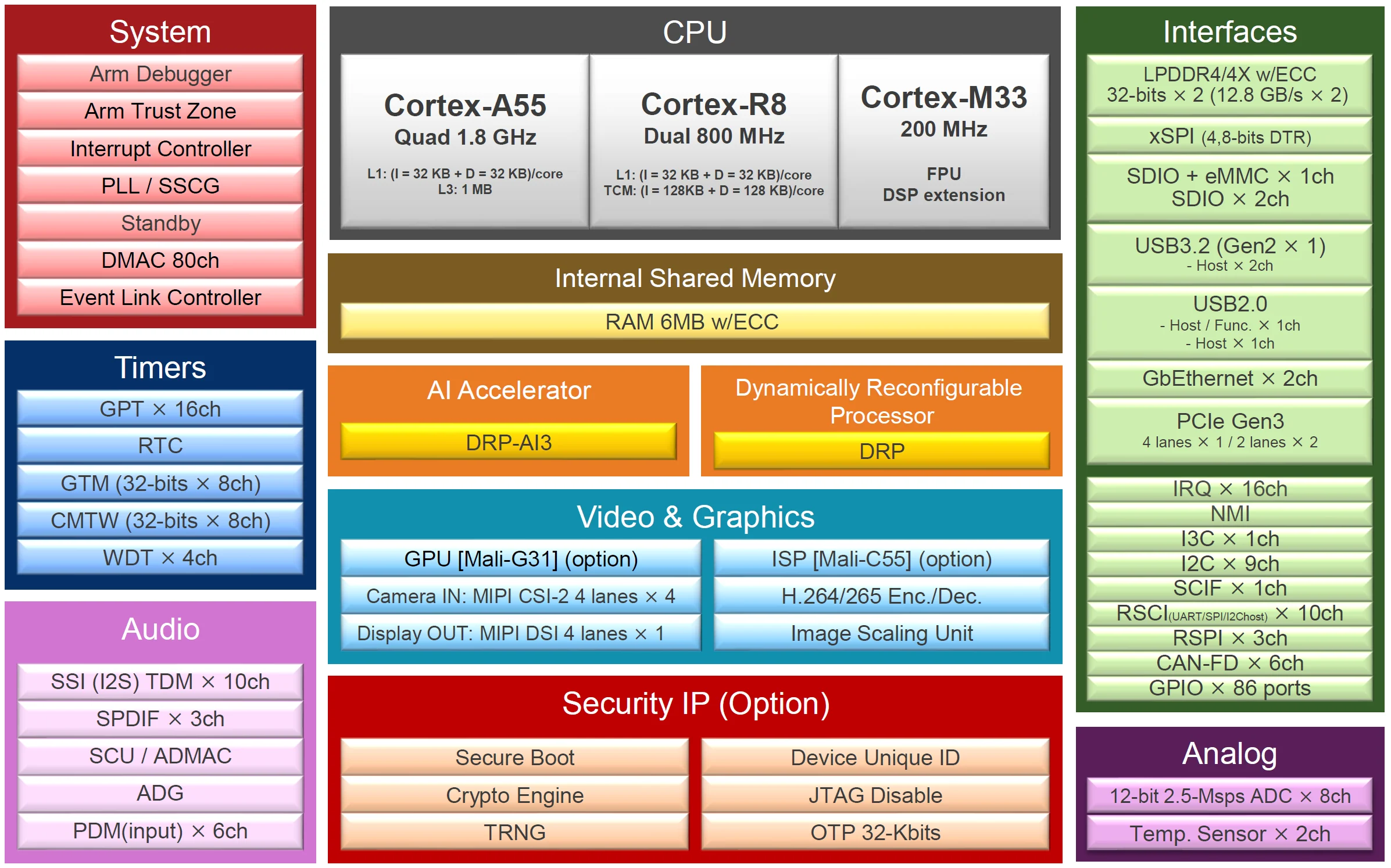
The RZ/V2H is a Renesas AI-accelerated multicore MPU built around a heterogeneous set of Arm cores: dual Cortex-A55 (application cores) plus dual Cortex-R8 (real-time cores), alongside a DSP and an AI-MAC (DRP-AI3) accelerator.
Supported MCUs
The following list includes MCUs from the RZ/V2H series and indicates whether they are supported in NuttX:
MCU |
Support |
Note |
|---|---|---|
R9A09G057 |
Yes |
CR8_0 core only |
Peripheral Support
The following list indicates peripherals supported in NuttX on the CR8_0 core:
Peripheral |
Support |
Notes |
|---|---|---|
CLOCK |
Yes |
BSP clock tree init (PLL), internal use only |
GIC |
Yes |
Interrupt controller init (CPU0 + per-CPU) |
MPU |
Yes |
Static PMSAv7 region table (ITCM/DTCM/SRAM/code) |
TIMER |
Yes |
MPCore Private Timer used as the system tick source |
SCI |
Yes |
Interrupt-driven SCI-B asynchronous UART on channels 0-9 |
GPIO |
Yes |
Basic operations (config/read/write), no interrupt support |
CLOCK
rzv2h_clockconfig() calls into bsp_clock_init() from the vendored
Renesas FSP BSP to program the PLL and clock tree. It is invoked once
during boot and is not user-configurable through Kconfig.
GIC
The Generic Interrupt Controller is brought up by up_irqinitialize(),
using NuttX’s common ARM GIC support: CPU0-only initialization followed by
per-CPU initialization.
MPU
A static PMSAv7 region table protects the CR8_0 memory map (ITCM, DTCM, SRAM and the executable code window). Regions are set up once at boot and are not reconfigurable at runtime.
TIMER
The Arm MPCore Private Timer is used as the system tick source, clocked
from the BSP clock tree and reloaded to match CLK_TCK.
SCI
The Serial Communication Interface (SCI) provides multiple serial
communication modes. NuttX currently supports interrupt-driven UART operation
on channels 0 through 9 through the SCI-B lower-half driver.
CONFIG_RZV2H_UART_SCI enables the driver and
CONFIG_RZV2H_SCI_B_UARTn selects each required channel. The standard
CONFIG_SCIn_* options configure the channel and select the console.
The driver supports early console output and registers the selected
console as /dev/console and /dev/ttyS0. Other enabled channels are
registered in ascending channel order.
Runtime baud-rate changes are supported through the standard termios
TCGETS and TCSETS operations.
Hardware flow control and DMA are not implemented yet.
GPIO
The GPIO driver provides fundamental support for pin configuration, read, and write operations. GPIO interrupt support is currently unavailable.
INTC SEL (Interrupt Select) Lines
The CR8 core’s INTC provides a
pool of 127 programmable “SEL” lines (SEL0-SEL126, GIC IRQ numbers
353-479) whose peripheral event mapping is set through the INTC INTSEL
registers. Peripheral drivers that need one of these programmable lines
request a specific SEL number and event through
rzv2h_intsel_connect_event().
Default SEL IDs
The 127-line SEL pool (SEL0-SEL126, IRQ 353-479) is conventionally partitioned by module, allocated from the top of the range downward:
Module |
Count |
IRQ range (>= 353) |
|---|---|---|
TINT |
32 (tint0-tint31) |
479-448 |