NXDoom
This game is a port of the Chocolate DOOM DOOM port to NuttX. The original Chocolate DOOM port is highly featured, and also adheres well to the vanilla DOOM experience. NXDoom is tailored instead for embedded devices and will likely have to forego some features or sacrifice some vanilla DOOM experience for better memory/CPU performance.
NXDoom is maintained inside the NuttX source tree because it will diverge heavily from the original Chocolate DOOM port in order to target embedded devices. It is for this reason that we do not take the approach of downloading Chocolate DOOM and apply patches (there would be too many large patches to apply).
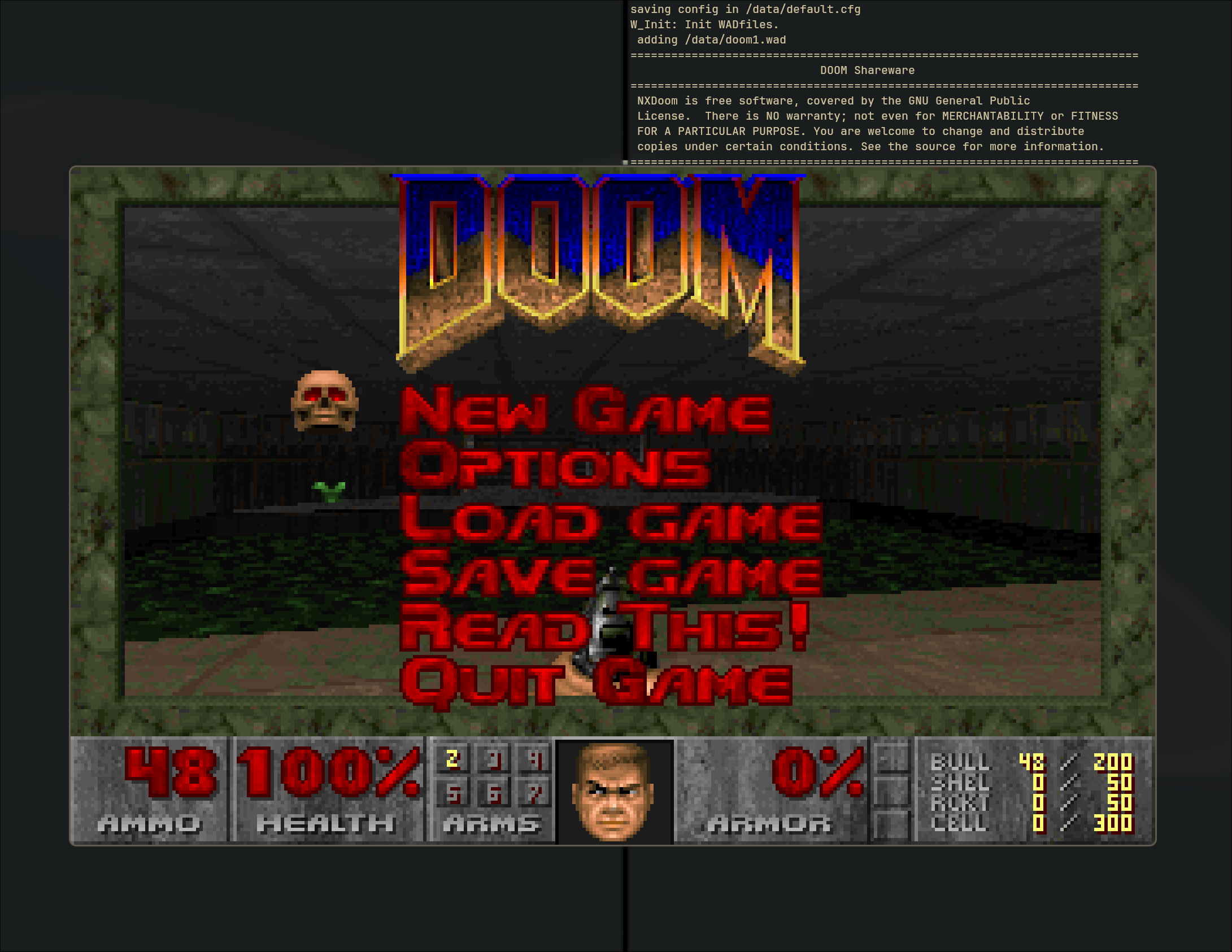
The shareware version of DOOM being played on the NuttX simulator
Warning
Not all features are implemented for NXDoom. There is currently no support for game sounds or music, nor does any of the networked logic for multiplayer games work.
Some code was stripped during the initial port to simplify the port. If those features are needed/desired later, they can be added back. This includes some sound-library interfaces which are not available on NuttX, some input options, etc.
It is recommended that if you are making any significant changes to the source code, you try compiling with and without the sound/networking feature flags enabled to catch any possible errors.
Todo
This port is a massive work in progress. Any contributions are welcome. Since memory is the primary constraint for many of the embedded devices running NuttX, memory optimizations are particularly welcome.
Sound support, multiplayer support, support for any of the wide array of input devices NuttX can provide are also highly welcomed.
Note
Keyboard input is the only input device supported so far, and other ones are welcome.
The game binds fire, run and strafe to Ctrl, Shift and Alt. Those reach
an application only if the keyboard driver reports a modifier as a key in
its own right, which the codec keycodes KEYCODE_LCTRL through
KEYCODE_RGUI exist for.
The simulator always reports them. A USB HID keyboard reports them when
CONFIG_HIDKBD_REPORT_MODIFIERS is enabled, which is off by default,
so a configuration that plays the game over USB has to turn it on. A
driver that reports no modifiers at all, a matrix keyboard for instance,
leaves those three actions on keys the game cannot see, and they have to
be rebound to play.
Minimum requirements
The minimum requirements for playing NXDoom are:
A device running NuttX
A device with graphics output controlled via a frame buffer driver (320x240 screen minimum resolution)
Some way of getting sufficient input for up/down/left/right/fire controls (limited out-of-the-box input support is available)
A pretty good amount of memory (I haven’t verified the total amount required yet, but the original DOOM needed 4MB of RAM and NXDoom isn’t much better optimized)
Non-volatile memory sufficiently large for the WAD file you choose to play
Note
The NXDoom port was tested using the shareware version of DOOM, whose WAD file is commonly named DOOM1.wad. You may find this online on various sites. Other WAD files are available online but are not guaranteed to work (i.e., the OTTAWAU.wad file I tried did not run properly)
Playing
To launch the game, just run:
nsh> nxdoom -iwad /path/to/my/iwadfile.wad
and replace the path with your WAD file’s path.
Tuning the display for a board
DOOM renders a 320x200 image with 8 bits per pixel and a palette, and the port scales that up and converts it to whatever the frame buffer wants. How much that costs depends a great deal on the board, so the following options are available. All of them are disabled by default, which leaves the behaviour unchanged, and each is worth enabling only where it pays.
CONFIG_GAMES_NXDOOM_FB_CMAPLoad the DOOM palette into the frame buffer’s colour map and blit the palette indices unconverted, letting the display convert them while it scans out. This needs a frame buffer that is 8 bits per pixel and supports
FBIOPUT_CMAP, such as an STM32 LTDC layer configured for L8. It removes the conversion from the blit and halves the amount of data written per frame.CONFIG_GAMES_NXDOOM_FILLSCREENStretch the image over the whole display instead of scaling it by the largest whole number that fits. This fills a display whose size is not an exact multiple of 320x200, at the cost of a scale factor that is not uniform across the image. Without it the image is scaled by a whole number and centred, leaving a border.
CONFIG_GAMES_NXDOOM_ROWSTAGEBuild each output row in a staging buffer and copy it out, rather than writing the frame buffer a pixel at a time, so that the frame buffer only ever sees burst-friendly copies. Costs a few kilobytes of
.bss. This is worth a lot when the frame buffer is external memory and the data cache is in write-through mode, and little otherwise.CONFIG_GAMES_NXDOOM_STATIC_SCRNBUFPlace the buffer DOOM renders into in
.bssrather than taking it from the heap, which puts it in internal RAM on a board whose heap is mostly external memory. The renderer draws in vertical columns, so consecutive writes are one screen width apart and none of them coalesce, which makes external memory close to the worst case for it. Costs 64000 bytes of RAM whether the game runs or not.
As an illustration of the effect, on an STM32H753 driving a 1024x600 panel
whose frame buffer lives in SDRAM, ROWSTAGE and STATIC_SCRNBUF are
worth 2.7 times the frame rate between them.
Other Notes
Translations
The game does support different translations via headers with game strings. One
such example is src/doom/d_french, which was my half-attempt at translating
the game strings to French (I stopped halfway). The main problem with
translations is that the game seems unable to render non-ASCII text (i.e. any
French words with accents have missing letters where the accents were). A way
around this would be great, and other translations are welcome.
Source Comments
I made an effort to preserve all the original comments from the Chocolate DOOM source, which in turn seems to have made an effort to preserve the original DOOM code comments. Some are quite vulgar.
Optimizations
DOOM uses 32-bit wide, signed fixed-point numbers for calculations. This should be entirely compatible with the NuttX fixed-point library. However, in my attempt to switch to the NuttX-native library, the textures began to render strangely and I experienced periodic crashes. This would be one good optimization.
Another useful optimization would be to eliminate the lookup tables used for sine, cosine and tangent. These make the game logic fast, but they also take up the most amount of memory in the binary. Removing them could save several hundred KB. CPUs have come a long way since DOOM was written and the compute hit might be worth it for the memory reduction on embedded.
Another good optimization would be to examine the use of 32-bit natural int
variables and decided if smaller sizes could be used. I imagine this was
originally done for the native word-size optimizations on the computers of the
era, but it results in extra memory use on large internal arrays especially.